


Silicon (Si) Optical Windows, Lenses and THz Components: CZ, FZ and HRFZ Grade
Alkor Technologies manufactures silicon optical windows, lenses, mirrors, beamsplitters and THz hemispheres from three grades of silicon — Czochralski (CZ), Float Zone (FZ) and High-Resistivity Float Zone (HRFZ-Si) — on our own production site in Saint Petersburg, Russia. Transmission range 1.2 µm – 7 µm for standard IR applications; 1.2 µm – 1000 µm+ for HRFZ-Si THz applications. Silicon is relatively lightweight, weighing in at just half the density of germanium, making it the preferred choice for weight-sensitive thermal imaging. Maximum window diameter 300 mm. AR coatings for 1.5–6 µm, 2–4 µm, 3–5 µm, 8–12 µm. DLC coatings available. Custom quote within 24 hours.
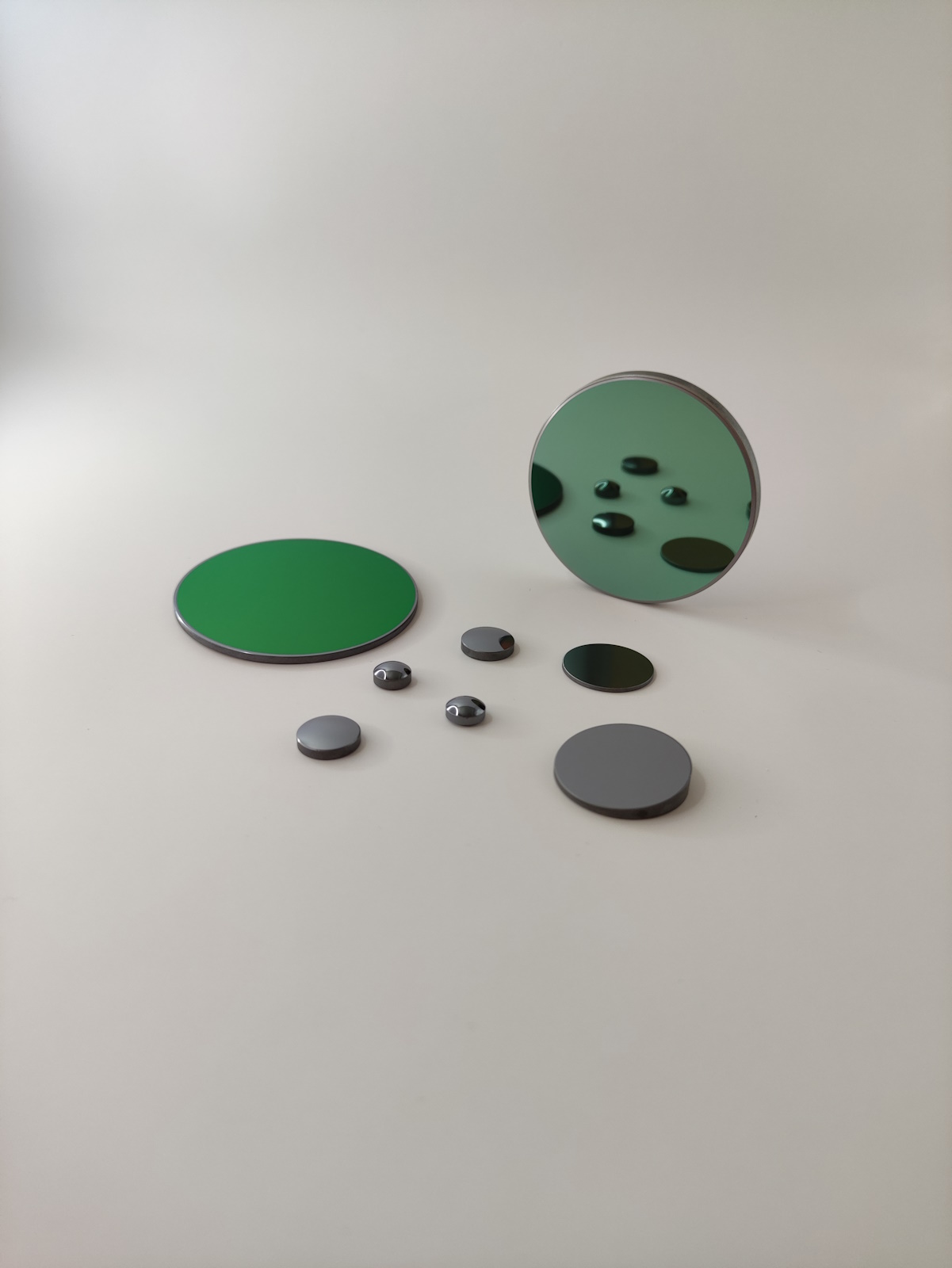
Products: Full Silicon Optical Component Range
Silicon Windows (CZ and FZ Grade)
Plane-parallel and wedged windows from 5 mm to 300 mm diameter — the largest production size we offer across any material. Circular and rectangular formats. CZ grade for MWIR 3–5 µm applications; thin FZ grade for LWIR 8–12 µm applications.
Silicon optics have some key properties that make them ideal in certain optical applications and systems. Silicon windows and lenses are frequently employed in NIR and MWIR thermal imaging applications. Silicon windows catalog
AR coatings available: 1.5–6 µm, 2–4 µm, 3–5 µm, 8–12 µm. DLC coating available for outdoor and abrasive environments.
Silicon Lenses
Plano-convex, bi-convex, plano-concave, meniscus, cylindrical Si lenses. Diameter 5 to 90 mm. CZ grade for MWIR focusing, collimation and gas analyzer lenses. Custom focal lengths and diameters to drawing.
Silicon optical lenses are ideal for collimation or focusing applications that utilize monochromatic light. These Si lenses are available in a range of sizes or focal lengths for a wide variety of application needs. Silicon lenses catalog
HRFZ-Si THz Lenses and Hemispheres
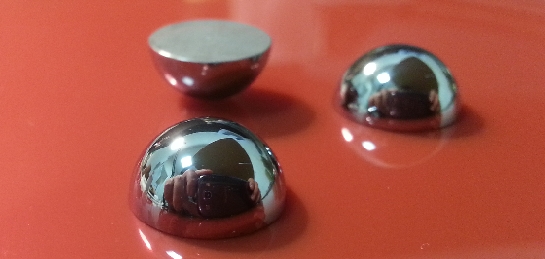
We offer HRFZ-Si lenses of different types: hyper-/hypo-/hemispherical, bullet, and meniscus.
We produce HRFZ-Si hemispheres (R2 – R12.7 mm) and hyper-hemispheres for immersion coupling to THz photoconductive antennas and bolometers. The hemisphere is placed directly against the flat face of the detector substrate (GaAs, InGaAs). The high refractive index of silicon (n ≈ 3.42) increases the effective NA of the detector:
— Hemisphere: effective NA increased by factor n (3.42×)
— Hyper-hemisphere: effective NA increased by factor n² (≈11.7×) — maximum possible coupling efficiency
This THz coupling is standard in time-domain THz spectroscopy (TDS) systems and THz near-field imaging. We also produce HRFZ-Si meniscus lenses for THz collimation and beam shaping in THz spectroscopy setups.
IR intereference filters
IR intereference filters, which are integrated into IR applications such as FTIR spectroscopy, are used to transmit or block a specific range of IR wavelengths. IR interference filters
Silicon Mirrors (Si+Au, Si+Ag)
Due to its high thermal capacity, silicon serves as an ideal substrate for reflectors, particularly in applications like CO₂ laser cutters.
Gold-coated silicon mirrors (Si+Au) for CO₂ laser beam delivery systems: reflectivity >97% at 10.6 µm across the full silicon mirror surface. The combination of silicon's high thermal conductivity and gold's high IR reflectance makes Si+Au the standard mirror specification for CO₂ laser cutting and engraving systems. Lighter than copper mirrors at equivalent aperture sizes.
Silver-coated silicon mirrors for NIR and MWIR applications where broadband reflectance from 400 nm to 10 µm is required.
Silicon ATR Prisms and Hemicylindrical Prisms
Silicon ATR (Attenuated Total Reflection) prisms for mid-IR spectroscopy. The critical angle for silicon (~17°) is smaller than for ZnSe (~25°) and much smaller than for CaF₂ (~44°) — meaning silicon ATR prisms support more internal reflections per unit length, providing higher signal-to-noise in ATR spectroscopy of strongly absorbing samples. Silicon prisms (ATR, hemicylindrical)
Three Silicon Grades: CZ, FZ and HRFZ-Si — Which to Choose
To solve various problems in different wavelength ranges, three types of optical silicon are produced: Czochralski Silicon (OCz-Si), Float Zone Silicon (FZ-Si) and High Resistivity Float Zone Silicon (HRFZ-Si).
The grade selection determines the spectral range, absorption characteristics and suitability for specific applications:
| Grade | Resistivity | Key spectral range | Distinguishing feature | Best for |
|---|---|---|---|---|
| CZ (Czochralski) | 10–40 Ω·cm | 1.2–6 µm | Si–O absorption band at 9 µm | MWIR 3–5 µm, gas analyzers, FTIR filters |
| FZ (Float Zone) | >1000 Ω·cm | 1.2–7 µm | No Si–O band, thin windows usable to 12 µm | LWIR thin windows, FTIR beamsplitters |
| HRFZ-Si | >10 000 Ω·cm | 1.2 µm – 1000+ µm | Virtually zero THz absorption | THz spectroscopy, THz detectors, hemispheres |
Besides synthetic diamond, high resistivity silicon is the only isotropic crystalline material suitable for the extremely wide wavelength range, from NIR (1.2 µm) to millimeter (1000 µm) and more.
Why Si resistivity matters for THz: Silicon's free carriers (electrons and holes) absorb electromagnetic radiation in the THz range. At standard CZ resistivity (10–40 Ω·cm), the material is nearly opaque at THz frequencies. The complex dielectric permittivity of silicon depends on its conductivity, i.e. free carrier concentration. Only HRFZ-Si with resistivity >10,000 Ω·cm achieves the near-zero free carrier concentration required for THz transparency.
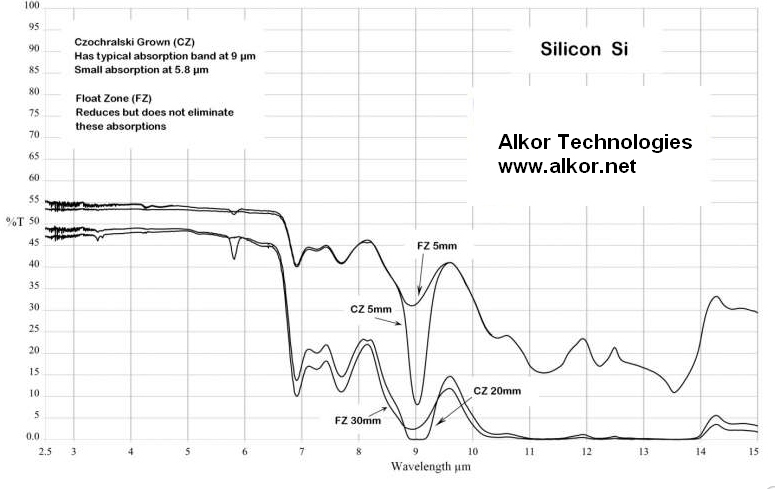
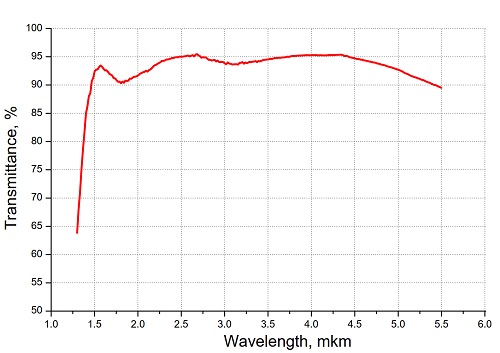
CZ grade Si practical note: At the mid-infrared range MWIR 3–5 µm, there is practically no difference in transmission between various types of optical grade silicon — for 3–5 µm applications, CZ is the cost-optimal choice. The Si–O absorption band at 9 µm is only relevant for LWIR applications requiring coverage beyond 7 µm.
FZ grade Si for LWIR: Silicon windows with thickness less than 0.5 mm can be used in the 8–14 µm spectral region — but only in FZ or HRFZ-Si grade, which lacks the Si–O band that blocks CZ silicon at 9 µm.
Silicon windows transmission
Silicon vs Germanium: Choosing the Right IR Material
| Parameter | Silicon (Si) | Germanium (Ge) |
|---|---|---|
| MWIR 3–5 µm coverage | ✓ excellent | ✓ excellent |
| LWIR 8–14 µm coverage | thin FZ only (<0.5 mm) | ✓ standard |
| Density | 2.33 g/cm³ | 5.33 g/cm³ |
| Weight advantage | 2.3× lighter than Ge | — |
| Refractive index | 3.42 | 4.00 |
| Reflection loss (uncoated) | 46% | 53% |
| THz transparency | HRFZ grade: excellent | opaque |
| Max operating temperature | 200°C (CZ grade) | 100°C |
| Relative cost | lower | higher |
| Natural 50/50 beamsplitter | ✓ yes (Fresnel) | ✓ yes (Fresnel) |
Choose silicon when:
— Weight is critical: MWIR optics for UAVs, portable systems, airborne payloads
— THz spectroscopy or THz detector immersion lenses (HRFZ-Si only)
— Operating temperature exceeds 100°C — germanium becomes opaque above ~100°C, silicon remains transparent to 200°C+
— MWIR 3–5 µm with cost optimisation (silicon is consistently less expensive than germanium for equivalent apertures)
— CO₂ laser mirrors where high thermal conductivity substrate is required
Choose germanium when:
— LWIR 8–14 µm imaging is required with standard window thickness
— The highest refractive index is needed for compact lens designs (n=4.0 vs 3.4)
— ATR spectroscopy (germanium's high n gives the most effective evanescent field penetration)
AR Coatings and DLC for Silicon Optics
Uncoated silicon reflects approximately 46% from two surfaces at 3–5 µm (n ≈ 3.42, ~23% per surface). AR coatings reduce this to below 2% per surface, nearly doubling throughput.
| Coating | Range | Residual reflection | Application |
|---|---|---|---|
| AR 1.5–6 µm | 1.5–6 µm | <3% | Broadband MWIR systems |
| AR 2–4 µm | 2–4 µm | <2% | NIR/SWIR to MWIR |
| AR 3–5 µm | 3–5 µm | <1% | MWIR cameras, gas analyzers |
| AR 8–12 µm | 8–12 µm | <2% | Thin FZ-Si LWIR windows |
| DLC | 2–14 µm | improves + protects | Outdoor MWIR |
| Uncoated | all Si ranges | ~46% | THz beamsplitters, lab use |
| Au coating | 1–25 µm | >97% reflectance | CO₂ laser mirrors, broadband IR mirrors |
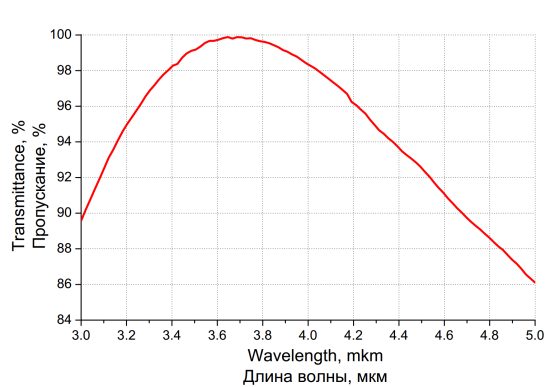
3.5-3.9µm AR/AR Coated Silicon window.
1.5-5µm AR/AR Coated Silicon window.
Request a Quote for Silicon Optics
Send your specifications to technologies@alkor.net: component type (window / lens / mirror / THz hemisphere / ATR prism), silicon grade (CZ / FZ / HRFZ-Si), dimensions, surface quality, coating and quantity. We will respond with a technical review and quote within 24 hours.
| Silicon properties | |
|---|---|
| Chemical Formula | Si |
| Molecular Weight | 28.09 |
| Crystal Class | Cubic |
| Lattice Constant, Е | 5.43 |
| Density, g/cm3 at 293 K | 2.329 |
| Dielectric Constant for 9.37 x 10⁹ Hz | 13 |
| Melting Point, K | 1690 |
| Thermal Conductivity, W/(m K) at 125 K at 313 K at 400 K |
598.6 163 105.1 |
| Thermal Expansion, 1/K at 75 K at 293 K at 1400 K |
-0.5 x 10⁻⁶ 2.6 x 10⁻⁶ 4.6 x 10⁻⁶ |
| Specific Heat, cal/(g K) at 298 K at 1800 K |
0.18 0.253 |
| Debye Temperature, K | 640 |
| Bandgap, eV | 1.1 |
| Solubility in water | None |
| Knoop Hardness, kg/mm2 | 1100 |
| Mohs Hardness | 7 |
| Young's Modulus, GPa | 130.91 |
| Shear Modulus, GPa | 79.92 |
| Bulk Modulus, GPa | 101.97 |
| Poisson's Ratio | 0.28 |
Optical grade Silicon - index of refraction
| µm | No | µm | No |
| 1.357 | 3.4975 | 1.367 | 3.4962 |
| 1.395 | 3.4929 | 1.5295 | 3.4795 |
| 1.660 | 3.4696 | 1.709 | 3.4664 |
| 1.813 | 3.4608 | 1.970 | 3.4537 |
| 2.153 | 3.4476 | 2.325 | 3.4430 |
| 2.714 | 3.4358 | 3.000 | 3.4320 |
| 3.303 | 3.430 | 3.500 | 3.4284 |
| 4.000 | 3.4257 | 4.258 | 3.4245 |
| 4.500 | 3.4236 | 5.000 | 3.4223 |
| 5.500 | 3.4213 | 6.000 | 3.4202 |
| 6.500 | 3.4195 | 7.000 | 3.4189 |
| 7.500 | 3.4186 | 8.000 | 3.4184 |
| 8.500 | 3.4182 | 10.00 | 3.4179 |
| 10.50 | 3.4178 | 11.04 | 3.4176 |