


Calcium Fluoride (CaF₂) Windows, Lenses and Prisms: Custom Manufacturing from Own Crystal Growth
Alkor Technologies manufactures custom calcium fluoride (CaF₂) optical components — windows, lenses, wedges, prisms and beamsplitters — from our own CaF₂ crystal growth facility in Saint Petersburg, Russia. We grow approximately 50 kg of CaF₂ crystal per month, which allows us to offer consistent high quality at highly competitive prices without dependence on third-party crystal suppliers. Transmission range 130 nm – 9 µm. Available in Excimer grade, VUV grade, UV grade, IR grade and Raman grade. Windows up to 220 mm (8") diameter. Custom quote within 24 hours.
We produce the following custom CaF2 optics:
CaF2 lenses with any focal length;
CaF2 windows up to 220mm diameter;
CaF2 wedges, prisms and CaF2 mirrors;
Excimer CaF2 optics, Raman grade CaF2 optics and etc.
Please send us your specifications, we will quote it within 24hrs.
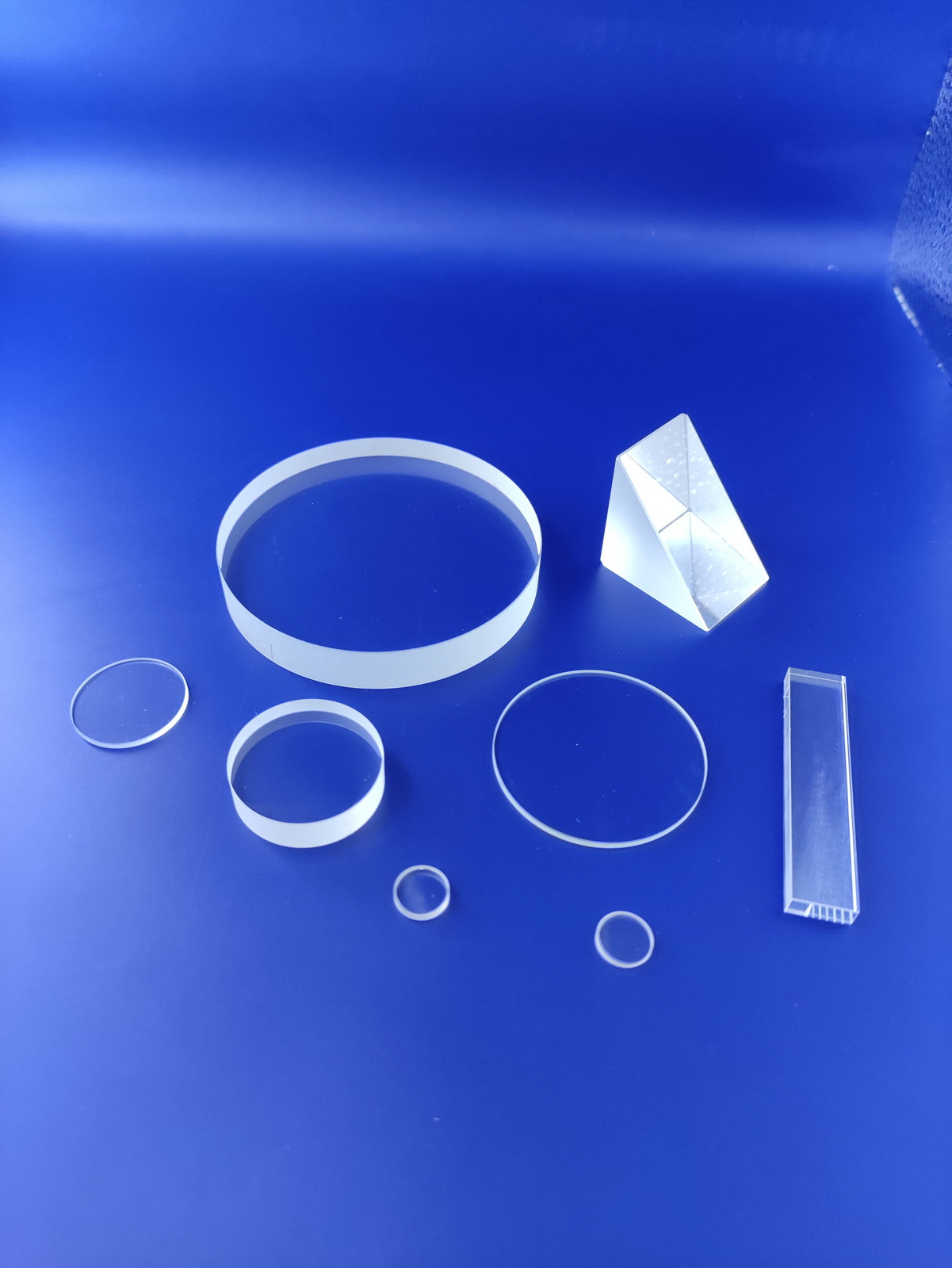
Products: Full CaF₂ Component Range
CaF₂ Windows
We produce plane-parallel CaF2 windows from 5 mm to 220 mm diameter. Circular and rectangular formats. Drilled CaF2 discs (windows with central bore) for gas cell assemblies. Standard polishing grade: S/D 60-40, flatness λ/2. Precision polishing: S/D 20-10, flatness λ/10. Parallelism to 10 arc seconds. With or without AR coating.
Since they are nonaxial, CaF2 crystals do not require consideration of axial direction. Because of CaF2 low refractive index, Calcium Fluoride windows can be used without an anti-reflection coating.
CaF₂ Lenses
We produce plano-convex, bi-convex, plano-concave, meniscus, cylindrical CaF2 lenses. Diameter 5 to 100 mm, focal length to order. Equivalents of Edmund Optics and Thorlabs CaF2 catalog lenses. AR coatings at specific wavelengths or broadband.
CaF₂ Wedges and Prisms
Wedge windows for interference suppression or beam steering. Equilateral dispersion prisms. Right-angle prisms. Custom geometries to drawing. Angular tolerances to 10 arc seconds.
Maximum diameter of CaF2 windows by Alkor - 220mm (8"). Alkor manufactures vacuum UV grade CaF2 windows and lenses (193nm and 157nm) upon request.
CaF₂ Beamsplitters
Plate beamsplitters (NPBS) and FTIR beamsplitter/compensator pairs. Transmission range ~1000–10 000 cm⁻¹ (1–10 µm) for FTIR NIR/MIR coverage beyond the KBr cutoff region. Specified R/T ratio and coating on request.
Why CaF₂: the one material that spans VUV, UV, VIS and MWIR
Calcium fluoride occupies a unique position among optical materials: it is one of the very few materials that is simultaneously:
Transparent from deep UV (130 nm) to MWIR (9 µm). Most UV-transparent materials (fused silica, MgF₂) transmit poorly beyond 3–4 µm. Most IR materials (ZnSe, Ge) are opaque below 500 nm. CaF₂ is a crystalline optical material with excellent transmission from UV up to the LWIR region. This broad, single-material coverage eliminates the need to design separate UV and IR optical paths.
Resistant to atmospheric moisture. CaF₂ windows offer high transmission from 200–7000 nm when used uncoated. Unlike KBr, NaCl and KCl — which dissolve in moisture — CaF₂ is practically stable under normal atmospheric conditions for years. It can be used in open-air laboratory environments without special precautions.
Low refractive index (n ≈ 1.43 at 5 µm). Because of CaF₂ low refractive index, CaF₂ windows can be used without an anti-reflection coating. At this index, Fresnel reflection loss from two surfaces is only ~6.4% — acceptable for many spectroscopic applications without any coating.
High laser damage threshold and low absorption. The high bulk damage threshold of calcium fluoride coupled with its low absorption makes it a popular choice for use with laser systems, including excimer lasers.
Optically isotropic — no birefringence. CaF₂ crystallises in the cubic system (Fm3m), which means it has no preferred crystallographic direction for optical propagation. No alignment of the crystal axis is required, unlike MgF₂ which is birefringent and requires orientation control for windows.
Lowest group velocity dispersion (GVD) among standard optical materials in the IR. CaF₂ has the lowest group velocity dispersion in the infrared region, making it widely used in femtosecond infrared systems. For ultrafast (femtosecond) laser systems, this is a critical selection criterion.
We have own growth facility for CaF2 crystal growth. We grow about 50kg of CaF2 crystals every month. That is why we can offer high quality Calcium Fluoride (CaF2) windows and lenses at very competitive price. Compare our prices now!
Simple guide to CaF2 grade: Excimer, VUV, UV, IR. Click here.
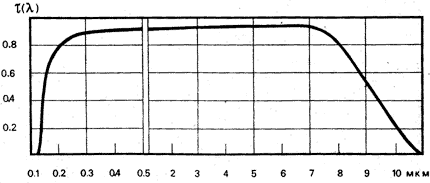
CaF2 transmission curve. Sample thickness 10mm.
Applications: Where CaF₂ Optics Work
Excimer Laser Systems (ArF 193 nm, KrF 248 nm, XeCl 308 nm)
CaF₂ is established as an industry standard material for excimer laser optics due to excellent laser durability at 193 nm and 248 nm. The combination of high transmission at 193 nm, very low absorption and radiation hardness makes Excimer grade CaF₂ the standard choice for beam delivery optics, resonator windows and output couplers in ArF and KrF laser systems. The exceptional damage threshold and minimal UV absorption of calcium fluoride render uncoated CaF₂ windows an ideal choice for excimer laser optics.
FTIR Spectroscopy (1 – 9 µm)
CaF₂ is the standard window and beamsplitter material for FTIR systems operating in the near-to-mid-IR range up to approximately 1100 cm⁻¹ (9 µm). IR grade CaF₂ provides excellent transmission across this range with minimal absorption, no water sensitivity, and easy handling without a dry-box environment. We produce FTIR cuvette windows and beamsplitter/compensator pairs in CaF₂ compatible with all major FTIR platforms.
Gas Detectors and Gas Analyzers (MWIR 3–5 µm)
Alkor Technologies produces CaF₂ windows and mirrors for manufacturers of gas detectors and gas analyzers. CaF₂ windows protect the detector and optical components of NDIR gas analyzers from the gas stream while transmitting the analytical IR beam at the characteristic absorption wavelengths of CO₂ (4.26 µm), CH₄ (3.33 µm), CO (4.67 µm) and other gases. The absence of water sensitivity is a key practical advantage in field instruments that may experience humidity fluctuations.
Cryogenically Cooled Thermal Imaging Detectors
Standard, IR grade calcium fluoride performs best in thermal imaging and FLIR applications where the infrared detector on thermal imaging systems is cooled, via cryogenic cooling, to keep the detector at a consistent, low temperature to reduce thermal noise. CaF₂ is chemically inert at cryogenic temperatures, mechanically stable through thermal cycling, and maintains its optical properties down to liquid nitrogen temperatures.
Femtosecond and Ultrafast Laser Systems
CaF₂ has the lowest group velocity dispersion in the infrared region among standard optical materials, making it widely used in femtosecond infrared systems. In ultrafast laser systems, group velocity dispersion (GVD) causes pulse broadening as the pulse propagates through optical elements. Minimising GVD is critical for maintaining pulse duration. CaF₂ is one of the preferred materials for windows, substrates and lenses in Ti:Sapphire, OPA and OPO systems operating across the 700 nm – 5 µm range.
UV Spectroscopy and Fluorescence Microscopy
CaF₂ transmits cleanly from 150 nm through the visible range, enabling UV spectrophotometry below 200 nm and fluorescence microscopy excitation at 355 nm, 335 nm and deeper UV wavelengths. Unlike fused silica, CaF₂ is also transparent into the mid-IR, making it ideal for broadband spectroscopic systems covering both UV and IR simultaneously.
VUV Spectroscopy and Synchrotron Beamlines
VUV grade and Excimer grade CaF₂ provide useful transmission down to 130 nm, covering the Lyman-α line of hydrogen (121.6 nm is below the cutoff — LiF required) and the full UV-spectroscopy range from 130 to 200 nm. CaF₂ is used as window material for vacuum monochromators, photolysis cells and synchrotron optical elements in the soft VUV range.
Request a Quote for CaF₂ Optics
Send your specifications to sales@alkor.net: component type (window / lens / wedge / prism), grade (Excimer / VUV / UV / IR / Raman), diameter or dimensions, thickness, surface quality, coating, quantity. We will respond with a technical review and commercial offer within 24 hours.
Download CaF2 datasheet in PDF.
| Chemical Formula | CaF2 |
| Crystal Class | Cubic, cleaves [111] plane |
| Lattice Constant, Е | 5.46 |
| Density, g/cm3 (20 °C) | 3.18 |
| Molecular Weight | 78.08 |
| Dielectric Constant for 105 Hz | 6.76 |
| Melting Temperature, K | 1630 |
| Thermal Conductivity, W/(m K) at 273 K | 10 |
| Thermal Expansion, 1/K at 300 K | 18.9 x 10⁻⁶ |
| Specific Heat, cal/(g K) at 273 K | 0.204 |
| Debye Temperature, K | 510 |
| Young's Modulus, GPa | 75.79 |
| Rupture Modulus, GPa | 0.0365 |
| Shear Modulus, GPa | 33.76 |
| Bulk Modulus, GPa | 83.03 |
| Poisson's Ratio | 0.28 |
| Knoop Hardness, kg/mm2 | 178 [100], 160 [110] |
| µm | No | µm | No | µm | No |
|---|---|---|---|---|---|
| 0.149 | 1.5800 | 0.161 | 1.5490 | 0.195 | 1.5000 |
| 0.200 | 1.4950 | 0.222 | 1.4800 | 0.248 | 1.4680 |
| 0.266 | 1.4621 | 0.280 | 1.4584 | 0.300 | 1.454 |
| 0.337 | 1.4481 | 0.400 | 1.4419 | 0.486 | 1.4370 |
| 0.588 | 1.4339 | 0.656 | 1.4325 | 0.687 | 1.4320 |
| 0.728 | 1.4314 | 0.884 | 1.4298 | 1.014 | 1.4288 |
| 1.100 | 1.4283 | 1.250 | 1.4275 | 1.650 | 1.4256 |
| 1.900 | 1.4244 | 2.058 | 1.4236 | 2.450 | 1.4214 |
| 2.700 | 1.4199 | 2.800 | 1.4192 | 3.050 | 1.4175 |
| 3.400 | 1.4149 | 4.000 | 1.4096 | 4.400 | 1.4057 |
| 4.800 | 1.4014 | 5.000 | 1.3991 | 5.304 | 1.3952 |
| 5.893 | 1.3871 | 6.483 | 1.3782 | 7.072 | 1.3681 |
| 7.661 | 1.357 | 8.251 | 1.3444 | 8.840 | 1.3308 |
| 9.429 | 1.3161 |