


Barium Fluoride (BaF₂) Windows, Lenses and Prisms: Own Crystal Growth, 150 nm – 12 µm
Alkor Technologies manufactures custom barium fluoride (BaF₂) optical components — windows, lenses, prisms, wedges and drilled discs — from our own BaF₂ crystal growth facility in Saint Petersburg, Russia. We grow approximately 50 kg of BaF₂ crystal per month using the Stockbarger technique, offering both optical grade and scintillation grade material from the same production line. Transmission range 150 nm – 12 µm. Maximum window diameter 200 mm. High-precision execution: S/D 20/10, flatness 0.25λ at 633 nm, parallelism to 10 arc seconds available up to 150 mm diameter. Custom quote within 24 hours.
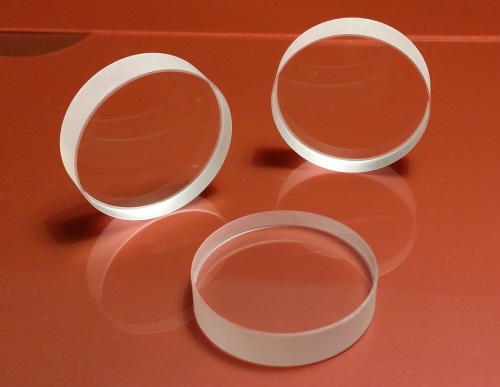
Products: Full BaF₂ Component Range
BaF₂ Windows
Plane-parallel windows and plates from 5 mm to 200 mm diameter. Circular and rectangular formats. Drilled discs (with central bore) for gas cell and spectroscopic cell assemblies. Maximum dimensions: 200 mm diameter × 40 mm thickness. Custom tolerances on request.
BaF2 windows catalog
BaF₂ Lenses
Plano-convex, bi-convex, plano-concave, meniscus. Diameter 5 to 100 mm. Custom focal lengths to specification. Equivalents of Edmund Optics and Thorlabs catalog items. AR coatings available.
BaF2 lenses catalog
BaF₂ Prisms and Wedges
Equilateral dispersion prisms, right-angle prisms, wedge windows. Angular tolerances to 10 arc seconds in precision execution. Custom geometries to drawing.
BaF₂ Beamsplitters and FTIR Pairs
Beamsplitter/compensator pairs for FTIR interferometers. Spectral coverage 1000–10 000 cm⁻¹ (1–10 µm). Specified R/T and coating on request.
What Makes BaF₂ Unique: Three Properties No Other Fluoride Combines
Barium fluoride competes directly with calcium fluoride in most optical applications — both are cubic fluoride crystals, both transmit from UV to mid-IR, both have low refractive indices and both are moisture-stable at room temperature. The reason to choose BaF₂ over CaF₂ comes down to three properties where BaF₂ is strictly superior:
1. Extended IR transmission — approximately 1 µm further than CaF₂. With an equivalent thickness, the transmission range of BaF₂ extends approximately 1 µm further into the long-wave IR region than calcium fluoride. CaF₂ cuts off around 9 µm (~1100 cm⁻¹); BaF₂ remains usefully transmitting to 12 µm (~833 cm⁻¹). This extra 3 µm covers the fingerprint region of the FTIR spectrum and is critical for analysis of inorganic compounds, heavy organics and metal carbonyls with characteristic absorption bands below 1000 cm⁻¹.
2. Highest radiation resistance among all optical fluorides. BaF₂ windows are the most resistant optical fluoride to high-energy radiation. Gamma rays, X-rays and fast neutrons darken most optical materials by generating colour centres that absorb in the UV and visible range. BaF₂ is uniquely resistant to this darkening, making it the material of choice for viewports in nuclear facilities, radiation detectors and high-energy physics experiments.
3. Fastest known scintillator. Barium Fluoride is the fastest known scintillator material. When BaF₂ is irradiated with ionising radiation, it produces two scintillation components: an ultra-fast component at 220 nm (τ ~ 0.6 ns) and a slower component at 310 nm (τ ~ 630 ns). The ultra-fast component makes BaF₂ the only crystal material capable of nanosecond timing resolution in particle physics coincidence experiments.
BaF2 scintillator grade crystals
Barium Fluoride windows, drilled discs, lenses and prisms, can be used in a variety of applications, such as infrared spectroscopy as demountable BaF2 cell windows, due to their wide broadband transmission that extend from UV to long-wave infrared.
BaF₂ vs CaF₂: Choosing the Right Fluoride for Your Application
Choose BaF₂ when:
— You need FTIR coverage beyond 1100 cm⁻¹ (9 µm), to ~833 cm⁻¹ (12 µm)
— The application involves high-energy radiation (nuclear, X-ray, gamma, particle physics)
— You need a scintillation window that also transmits both the UV emission and IR
— Chemical HF/DF laser applications (BaF₂ is resistant to fluorine chemistry)
Choose CaF₂ instead when:
— The 130–9 µm range is sufficient
— Mechanical durability is a priority (Knoop 158 vs 82 — CaF₂ is nearly twice as hard)
— The application involves thermal cycling or rapid temperature changes
— Extended room-temperature exposure to moisture without controlled storage
Applications: Where BaF₂ Optics Are Used
FTIR Spectroscopy (Extended MIR to 12 µm)
Due to barium fluoride's impressive transmission range from 200 nm up to 12 µm, it is well suited for use in FTIR spectrometers. As beamsplitter/compensator pair material or as cuvette window, BaF₂ covers the spectral range from approximately 10 000 cm⁻¹ down to ~833 cm⁻¹ — encompassing the full mid-IR fingerprint region including the low-wavenumber bands of inorganic salts, metal carbonyls, coordination compounds and heavy organic molecules that fall below the CaF₂ cutoff.
We supply BaF₂ cuvette windows in standard sizes compatible with major FTIR platforms (Thermo Fisher Nicolet, PerkinElmer, Agilent, Shimadzu) and custom-sized windows and beamsplitter pairs to specification.
Chemical Lasers: HF and DF (2.7–4.0 µm)
BaF₂ crystal is an ideal window material for CO₂ lasers and other laser windows in the UV-IR range. More importantly, BaF₂ is the standard output window for hydrogen fluoride (HF, 2.7–3.0 µm) and deuterium fluoride (DF, 3.6–4.0 µm) chemical lasers.
The combination of:
— high transmission at 2.7–4.0 µm (fully within BaF₂ range, well within CaF₂ range but BaF₂ tolerates fluorine environments better)
— resistance to HF gas chemistry
— high laser damage threshold
makes BaF₂ the preferred output coupler and beam-delivery window for these systems.
We supply BaF₂ windows and lenses for HF/DF laser applications with high-precision polishing and verified LIDT on request.
IR Thermography and Thermal Imaging Viewports (8–12 µm)
Barium fluoride viewports are often used in IR thermography due to their transmission in the MWIR and LWIR wavebands. Thin BaF₂ windows (1–3 mm) transmit in the 8–12 µm atmospheric window, making them suitable as viewport windows in industrial thermal imaging systems. BaF₂ spectroscopic and viewport windows are often used for the 8–11 µm wave range for high transmission.
We supply BaF₂ viewport windows for thermographic inspection equipment used in power grid maintenance, industrial process monitoring and building envelope inspection.
High-Energy Physics and Radiation-Hard Viewports
BaF₂ windows are the most resistant optical fluoride to high-energy radiation. In accelerator environments, reactor diagnostics and nuclear material handling facilities, viewports must maintain transmission after cumulative gamma and neutron dose. BaF₂ is the standard specification material for these applications.
Scintillation Detectors: Fastest Known Scintillator
Barium Fluoride is the fastest known scintillator material and is used in VUV and infrared spectroscopy. BaF₂ scintillators are used for Positron Emission Tomography (PET) and nuclear physics applications.
Alkor manufactures scintillation-grade BaF₂ crystals with controlled purity for:
— PET scanner detector arrays (fast coincidence timing from the 220 nm component, τ ~ 0.6 ns)
— High Energy Physics experiments requiring sub-nanosecond timing
— Gamma and X-ray spectroscopy where fast timing is required
Optical windows and scintillator crystals from the same material system and the same growth facility simplify vendor qualification.
UV and VUV Spectroscopy (150 nm – 400 nm)
BaF₂ transmits from 150 nm — slightly deeper than CaF₂ (130 nm) — through the UV and into the visible. For photolysis chambers, vacuum-UV spectroscopy systems and synchrotron optical elements operating in the 150–300 nm range, BaF₂ provides adequate VUV performance. Note: prolonged exposure to moisture degrades UV transmission by forming surface hydroxide layers. For critical VUV applications in humid environments, dry storage is required.
Astronomy and Astrophysics /
BaF₂ transmission and radiation hardness make it applicable in space instrumentation where UV transmission, IR transparency, and radiation dose from the space environment are all considerations. We supply custom-dimension BaF₂ windows for research instrument programs.
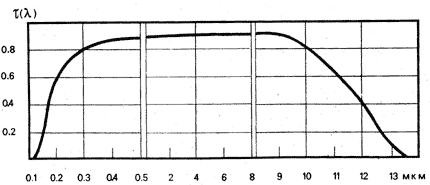
BaF2 transmission curve. Window thickness 10mm.Check another thickness here.
Handling BaF₂: Practical Notes
BaF₂ has two important practical limitations that users must understand: Extreme thermal shock sensitivity. These optical windows are very sensitive to thermal shock. BaF₂ has a relatively low thermal conductivity (11.7 W/(m·K)) and a higher thermal expansion than CaF₂ — combined with moderate brittleness (Knoop 82), rapid temperature change easily generates fracture. Never heat or cool BaF₂ components faster than ~2°C/minute. Do not expose to rapid convective cooling. Do not place a cold window on a hot surface.
UV transmission degrades in moisture at elevated temperatures. At room temperature, BaF₂ is adequately stable in normal atmospheric humidity — polished surfaces survive years of normal exposure. Barium fluoride windows can be used up to 800°C in a dry environment, but prolonged exposure to moisture can degrade transmission in the ultraviolet range. Above 500°C in humid environments, surface hydroxide formation begins and UV transmission degrades. For high-temperature applications, use in dry or inert atmosphere.
Cleaning: Use dry, lint-free optical tissue for dry wipe. For contaminated surfaces, absolute ethanol or acetone applied with lens tissue. Do not use water or aqueous solutions. Handle wearing clean gloves — fingerprint acids etch the surface slowly.
Storage: In sealed packaging with silica gel desiccant for long-term storage or in controlled-humidity environments (<40% RH).
To calculate minimum thickness of a BaF2 window required for a given pressure, click here.
In addition, scintillation grade BaF2 is usually used as scintillator for gamma detection. It is the fastest scintillating crystals up to now and is used in High Energy Physics Experiments.
Download BaF2 datasheet in PDF.
BaF2 main properties: |
|
|---|---|
| Chemical Formula | BaF2 |
| Crystal Class | Cubic |
| Molecular Weight | 175.36 |
| Lattice Constant, Е | 6.196 |
| Density, g/cm3 (20 °C) | 4.89 |
| Knoop Hardness, kg/mm2 | 82 |
| Young's Modulus, GPa | 53.05 |
| Shear Modulus, GPa | 25.4 |
| Bulk Modulus, GPa | 56.4 |
| Apparent Elastic Limit, MPa | 26.89 |
| Poisson Ratio | 0.343 |
| Dielectric Constant for 2 x 10⁶ Hz | 7.33 |
| Melting Temperature, K | 1550 |
| Specific Heat, cal/(g K) at 274 K | 0.096 |
| Thermal Conductivity, W/(m K) at 286 K | 11.7 |
| Thermal Expansion, 1/K at 300 K | 19.9 x 10⁻⁶ |
| Bandgap, eV | 9.1 |
| Solubility, g/100 g H2O | 0.17 |
BaF2 index of refraction
| µm | No | µm | No | µm | No |
|---|---|---|---|---|---|
| 0.1408 | 1.8150 | 0.1452 | 1.7820 | 0.1477 | 1.7670 |
| 0.1500 | 1.6780 | 0.2000 | 1.557 | 0.2652 | 1.5122 |
| 0.2803 | 1.5066 | 0.2893 | 1.5039 | 0.2967 | 1.5019 |
| 0.3021 | 1.5004 | 0.3130 | 1.4978 | 0.3254 | 1.4952 |
| 0.3403 | 1.4925 | 0.3466 | 1.4915 | 0.3610 | 1.4894 |
| 0.3663 | 1.4887 | 0.4046 | 1.4844 | 0.5461 | 1.4759 |
| 0.5893 | 1.4744 | 0.6438 | 1.4730 | 0.6563 | 1.4727 |
| 0.7065 | 1.4718 | 0.8521 | 1.4699 | 0.8944 | 1.4694 |
| 1.0140 | 1.4685 | 1.1287 | 1.4678 | 1.3673 | 1.4667 |
| 1.5295 | 1.4661 | 1.6810 | 1.4656 | 1.7012 | 1.4655 |
| 1.9701 | 1.4647 | 2.3254 | 1.4636 | 2.6738 | 1.4623 |
| 3.2434 | 1.4602 | 3.4220 | 1.4594 | 5.1380 | 1.4501 |
| 5.5490 | 1.44732 | 6.2380 | 1.4422 | 6.6331 | 1.4390 |
| 7.0442 | 1.4353 | 7.2680 | 1.4331 | 9.7240 | 1.4051 |
| 10.346 | 1.3936 |